Why Concrete Cracks in Nashville — And What Homeowners Should Do About It
You walk outside one morning and notice it — a crack running across your driveway, patio, or sidewalk that wasn't there last season. Maybe it's hairline thin. Maybe it's wide enough to catch your shoe. Either way, the question is the same: why did this happen, and what do I do about it?
Cracked concrete is one of the most common calls we receive from Nashville homeowners. And while cracks are frustrating, they're not always a sign of serious trouble. Some are cosmetic. Some are early warnings. Some mean the slab is done. Knowing the difference saves you money and prevents small problems from becoming expensive ones.
This guide walks through the most common causes of concrete cracking in Nashville, how to tell what you're dealing with, and when to repair versus when to replace.
Why Nashville Is Harder on Concrete Than Most Cities
Before getting into specific causes, it helps to understand why Nashville in particular produces so many cracked concrete calls. The city's geology and climate create a combination of stressors that accelerates concrete failure when installation isn't done correctly.
Nashville sits on a layer of expansive clay soil. This type of soil shrinks significantly during dry periods and swells when it absorbs moisture — and it does both dramatically and repeatedly across Tennessee's wet springs, dry summers, and fluctuating winters. Every time the soil moves, it pushes or pulls the concrete slab sitting on top of it. A slab without adequate base support doesn't have anywhere to go except into a crack.
Add to that Nashville's freeze-thaw cycles. While Middle Tennessee doesn't see the brutal winters of the upper Midwest, it gets enough below-freezing nights — often followed by above-freezing days — that water infiltrating concrete joints and surface pores repeatedly expands and contracts. Over time, this breaks down the surface and widens existing cracks.
The result is that Nashville concrete which was installed without proper base preparation and a quality mix design tends to fail faster and more visibly than it would in more forgiving climates. Good installation practices matter more here, not less.
The Most Common Reasons Concrete Cracks in Nashville
1. Shrinkage During Curing
This is the most common cause of concrete cracking — and the one that's most normal. When concrete cures, it releases water and shrinks slightly in volume. That shrinkage creates internal tension, and tension in a rigid material means cracks.
Shrinkage cracks are typically thin — hairline width or slightly wider — and appear within the first few weeks or months after a pour. They're usually random in pattern and relatively uniform in width. In most cases, shrinkage cracks are cosmetic and don't affect the structural integrity of the slab.
Properly placed control joints — the straight lines cut or formed into concrete slabs — are designed to give shrinkage cracks a place to happen in a controlled, predictable way. When control joints are missing or poorly spaced, shrinkage cracks appear wherever the slab is weakest, which is usually the worst possible place.
2. Inadequate Base Preparation
This is the most common cause of concrete that fails structurally — and the one that's entirely preventable with proper installation.
When a concrete slab lacks a properly compacted aggregate base beneath it, it has no stable, uniform support. As Nashville's clay soil shifts with moisture and temperature changes, sections of the subgrade move at different rates. Parts of the slab end up unsupported — effectively spanning a gap — and the concrete cracks under its own weight and any load placed on it.
These cracks tend to be wider, more irregular, and often accompanied by vertical displacement — meaning one side of the crack is higher than the other. This is a structural failure, not a cosmetic one, and it cannot be permanently fixed by filling the crack. The underlying cause — inadequate support — is still there.
If your driveway or patio was installed by a low-bid contractor who skipped proper excavation and base compaction, this is likely what you're dealing with.
3. Tree Roots
Nashville's mature tree canopy is one of the city's best features and one of the most reliable sources of cracked concrete. Tree roots follow moisture and nutrients, and the soil beneath a concrete slab is exactly the kind of stable, damp environment they seek.
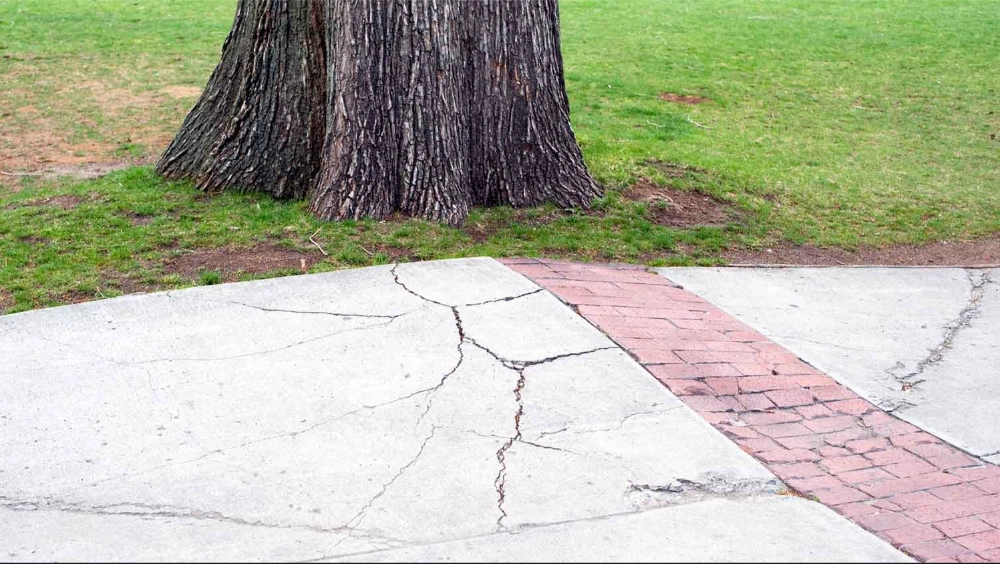
Root intrusion cracks are usually identifiable by their location — near trees — and their pattern. The crack typically follows the path of the root, and the concrete surface often shows visible heaving or lifting on one or both sides of the crack. As the root grows, the crack widens and the displacement increases.
Repairing concrete over an active root intrusion without addressing the root is a temporary solution at best. The root will continue to grow, and the crack will return. In many cases, the right answer involves either removing the tree, rerouting the root system, or accepting that the concrete in that area will need periodic replacement.
4. Freeze-Thaw Damage
Nashville gets enough freeze-thaw cycles each winter to cause real damage to concrete that isn't built to handle it. Water infiltrates the surface pores and joints of a concrete slab, freezes and expands, then thaws and contracts. Over multiple cycles, this breaks down the surface layer — a process called spalling — and widens any existing cracks by repeatedly forcing them open from within.
Air-entrained concrete — which includes microscopic air bubbles that give water room to expand without cracking the surrounding material — handles freeze-thaw cycles dramatically better than non-air-entrained mixes. Concrete installed without air entrainment in Nashville is significantly more vulnerable to this type of deterioration over time.
Surface spalling from freeze-thaw damage typically appears as flaking, pitting, or scaling on the top surface of the concrete. It's often worst near edges and joints where water infiltration is highest.
5. Overloading
Residential concrete driveways are typically designed for passenger vehicles. When heavy equipment — delivery trucks, dumpsters, moving vans, concrete trucks — parks or drives on a residential slab, it can exceed the load the slab was designed to carry.
Overload cracks tend to appear in patterns that follow the stress path of the load: radiating from the point of contact, or running parallel to the direction of travel. They're often accompanied by surface crushing at the point of heaviest load.
If heavy vehicles regularly access your property — RVs, trailers, work trucks — a thicker slab with additional reinforcement should have been specified at installation. A standard 4-inch residential driveway is not designed for that use.
6. Poor Concrete Mix or Finishing
Adding too much water to a concrete mix to make it easier to pour and finish is one of the most common shortcuts taken on job sites. A wetter mix is more workable — it flows more easily and is simpler to finish. It also produces significantly weaker concrete that is far more prone to cracking and surface deterioration.
Similarly, finishing concrete while bleed water is still present on the surface — another common shortcut — traps that water near the top of the slab. This creates a weak layer just below the surface that is susceptible to flaking, scaling, and cracking under normal use.
These are installation quality failures. They're invisible at the time of the pour and show up months or years later as premature cracking, surface scaling, or structural failure.
7. Settlement and Erosion
Over time, soil beneath a concrete slab can erode or compress — particularly in Nashville's clay-heavy ground, which can lose volume significantly during extended dry periods. When the soil settles unevenly, sections of the slab lose support and crack under their own weight.
Settlement cracks often appear in patterns that mirror the voids below: diagonal cracks running from corners, or sections that visibly sag or dip relative to surrounding areas. In some cases, the slab can be releveled through a process called mudjacking or slabjacking — pumping material beneath the slab to restore uniform support. In others, the degree of settlement requires full replacement.
Repair or Replace? How to Tell the Difference
Not every cracked concrete slab needs to be torn out and replaced. But not every crack can be fixed with a tube of crack filler from the hardware store either. Here's an honest framework for thinking through the decision.
Repair is generally appropriate when:
- Cracks are hairline to 1/4 inch wide with no vertical displacement between sides
- The slab is structurally sound with no visible sinking, heaving, or rocking
- The cracking is limited to a small percentage of the overall surface area
- The slab is less than 15 years old and was installed with proper base preparation
- The cause of cracking — such as a tree root — has been or can be addressed
Replacement is usually the better investment when:
- Cracks are wide, numerous, or show vertical displacement — one side higher than the other
- Sections of the slab have sunk, heaved, or become a trip hazard
- The slab is 20 or more years old with widespread surface deterioration
- The underlying cause is inadequate base preparation — no repair will fix the foundation problem
- You've already repaired the same areas more than once
- You want a decorative finish — resurfacing over a failing slab won't last
The honest reality is that many Nashville homeowners spend $1,500 to $3,000 on crack repairs and end up replacing the slab within three to five years anyway. When the cracking is structural rather than cosmetic, repairs address the symptom but not the cause. A free assessment from a reputable Nashville concrete contractor can tell you definitively which situation you're in.
What to Do When You Notice Cracking
If you've spotted cracks in your Nashville driveway, patio, or other concrete flatwork, here's what we recommend.
Don't ignore it. Small cracks are far cheaper to address than large ones. Water infiltrates cracks, freeze-thaw cycles widen them, and what starts as a minor surface issue can become a structural failure over two or three winters. Catching it early expands your options.
Don't immediately reach for hardware store crack fillers. For hairline cosmetic cracks on an otherwise sound slab, a quality polyurethane or epoxy crack filler can be appropriate. But for anything wider than hairline, or for cracks with displacement, a consumer-grade filler is a temporary cosmetic patch that won't address the underlying cause.
Document what you're seeing. Take photos that show the width of the crack, its length, and whether there is any vertical displacement between the two sides. Note whether the crack has appeared recently or has been present for some time. This information is useful when a contractor assesses the situation.
Get a professional assessment. A reputable concrete contractor in Nashville will assess the slab, identify the likely cause of cracking, and give you an honest recommendation — repair versus replace, and what either option costs. This assessment should be free. If a contractor charges for an estimate, that's unusual in this market.
How Urbanstead Concrete Handles Crack Repair and Replacement in Nashville
We assess and repair concrete driveways, patios, sidewalks, and foundations across Nashville and the surrounding communities. Our process starts with an honest evaluation — we'll tell you directly whether your slab is worth repairing or whether replacement is the better long-term investment.
For slabs that are good candidates for repair, we use professional-grade polyurethane and epoxy injection systems, not consumer fillers. We address the crack itself and, where possible, the underlying cause. If tree roots are involved, we'll tell you what your options are. If the base is compromised, we'll tell you that too.
For slabs that need replacement, we do the job correctly from the ground up: proper excavation, compacted aggregate base, 4,000–5,000 PSI air-entrained concrete, strategic control joint placement, and premium sealing. The problems that caused your last slab to fail won't be present in the new one.
Our current lead time for Nashville projects ranges from 1 to 6 weeks. We serve Nashville, Brentwood, Franklin, Nolensville, Spring Hill, and surrounding communities.
Not Sure Whether to Repair or Replace?
We offer free on-site assessments for Nashville homeowners. We'll tell you honestly what you're dealing with and what it will cost to fix it right.
Call or text [YOUR PHONE] | urbansteadconcrete.com
Frequently Asked Questions
Is it normal for new concrete to crack in Nashville?
Some cracking in new concrete is normal and expected. Hairline shrinkage cracks that appear within the first few weeks or months of a pour are common and typically cosmetic — they don't affect the structural integrity of the slab. What's not normal is wide cracking, cracking with vertical displacement, or significant cracking within the first year or two. That usually points to installation quality issues rather than normal concrete behavior.
Can cracked concrete be repaired without replacing the whole slab?
Yes, in many cases. Cracks that are narrow, stable, and without vertical displacement are good candidates for professional repair using epoxy or polyurethane injection. However, cracks caused by inadequate base preparation, significant settlement, or widespread structural failure are better addressed through full replacement. A professional assessment will tell you which situation applies to your slab.
What causes concrete driveways to crack in Nashville specifically?
The most common causes in Nashville are Nashville's expansive clay soil shifting with moisture changes, inadequate base preparation during installation, freeze-thaw cycles during winter, tree root intrusion, and overloading from heavy vehicles. Of these, inadequate base preparation is the most common cause of serious structural cracking — and it's entirely a function of how the driveway was installed.
How much does concrete crack repair cost in Nashville?
Professional concrete crack repair in Nashville typically runs $3–$7 per square foot for resurfacing or $300–$800 for isolated crack injection on a driveway or patio. Full replacement of a two-car driveway runs $5,000–$12,000 depending on size, finish, and site conditions. If your slab requires multiple repairs over a short period, replacement often delivers better value per year of service life.
How do I know if my cracked concrete needs to be replaced or just repaired?
The key indicators for replacement are: cracks wider than 1/4 inch, visible vertical displacement between the two sides of a crack, sections that have sunk or heaved, widespread cracking across the surface, and a slab that is 20 or more years old. If you're unsure, a free on-site assessment from a reputable Nashville concrete contractor will give you a definitive answer.
Keywords: cracked concrete Nashville, concrete crack repair Nashville, concrete repair Nashville TN, driveway crack repair Nashville, why does concrete crack Nashville, concrete repair companies Nashville TN
Get Your Free Quote
Other Related Posts
.webp)
Stamped Concrete Patios in Nashville: Costs, Patterns & What to Know
.webp)